
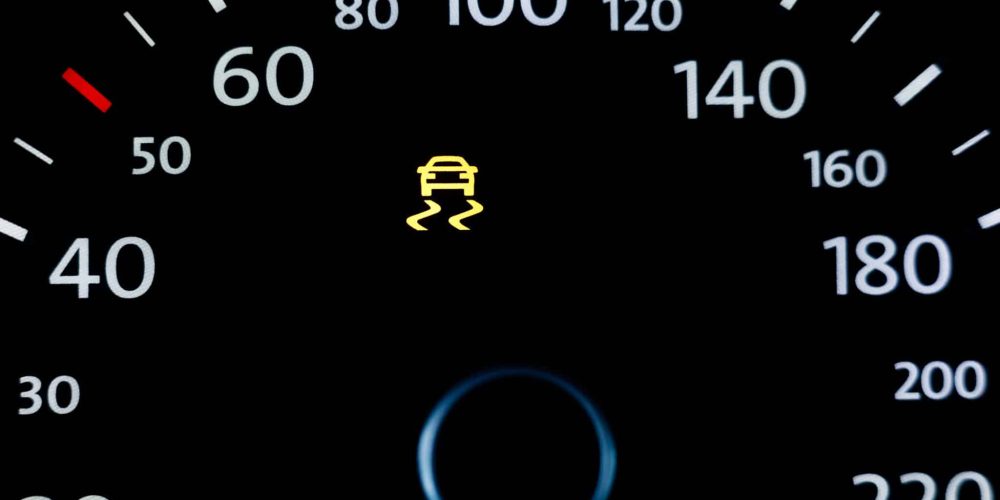
Your dashboard just lit up with a symbol you’ve maybe never seen before, the traction control light. Is it safe to keep driving? Is something seriously wrong with your vehicle? The truth is, traction control plays an essential role in keeping your car stable and safe, especially in slick or slippery conditions. In this post, we’ll explain what the traction control system does, why the warning light may appear, and what steps you should take when it does. We’ll also cover how this system ties into your car’s broader safety tech and when professional diagnostics or calibration might be necessary.
How Traction Control Helps You Drive Safely
Traction control is one of those safety features you rarely think about until the moment you need it. Most of the time, it runs quietly in the background, monitoring your vehicle’s grip on the road and stepping in when things start to slip.
The Traction Control System (TCS) exists for one main reason: to help keep your drive wheels from spinning when you accelerate. That matters because when your tires lose traction, your vehicle can lose stability faster than most people realize, especially in real-world conditions like rain, snow, black ice, or loose gravel.
You might notice traction control step in during everyday situations like pulling away from a stoplight after a storm, accelerating uphill on winter roads, or even starting from a stop when the pavement is slick. In some cases, it can activate on surfaces that surprise drivers, like painted lane markers, steel plates, or wet bridge grates.
One detail that matters a lot is whether the traction control light is flashing or staying on. A flashing traction control light often means the system is actively working. A solid traction control light often means the system is disabled or has detected a fault.
Why Is My Traction Control Light On?
When the traction control light comes on, it can make you feel like your vehicle is suddenly unsafe, or like something major is failing under the hood. But the truth is, this light can come on for reasons that range from normal driving conditions to real system faults.
Sometimes, the explanation is simple. Your tires slipped momentarily, and the system stepped in to correct it. If you were driving in rain, snow, or icy conditions and the light flashed and turned off, that’s usually the system doing its job.
If the light stays on, though, that’s when it becomes important to take it seriously. A steady traction control light is often a sign the system is not fully available, which means you might not have full traction management if the vehicle starts to slip again.
The steering angle sensor tells the vehicle’s computer the precise angle of the steering wheel. If this sensor fails or becomes misaligned, the TCS can’t properly interpret the driver’s intentions versus the vehicle’s actual direction of travel. This mismatch in data triggers a fault code and lights up the warning light.
ABS-related problems can also trigger the traction control warning. Since traction control often relies on the same sensor network and braking control logic as ABS, an ABS fault can cause traction control to shut down as well. If the ABS light and traction control light come on together, it usually points to a system-level issue rather than a one-off traction event.
Tires themselves can cause traction control warnings more often than people expect. Traction control depends on accurate wheel speed comparison. If one tire has low air pressure or a different rolling diameter, it can rotate at a different speed than the others. Your vehicle may interpret that as wheel slip even when traction is actually fine.
Here are a few tire-related situations that commonly trigger traction control warnings:
- One tire is significantly underinflated
- A temporary spare tire is installed
- Tires are mismatched in size or rolling diameter
- Tread depth differs dramatically between tires
Finally, there’s a modern and increasingly common cause that deserves special attention: calibration needs after repairs. Many vehicles integrate traction control with broader electronic safety systems. After certain work, such as alignments, collision repairs, suspension service, module replacements, or windshield replacement on vehicles with forward-facing cameras, the system may require calibration to operate properly.
How to Diagnose Traction Control Problems
Diagnosing traction control issues is all about narrowing down the scenario. You’re trying to figure out whether the system is doing its job normally, or whether a component fault is preventing it from operating correctly.
- Check whether the light is flashing or solid
- Flashing usually means the system is actively correcting wheel slip.
- Solid usually means the system is disabled or there’s a stored fault.
- Scan the dashboard for other warning lights
- If the ABS light is on, that’s a major clue since ABS and traction control share sensors and modules.
- If the tire pressure light is on, tire conditions may be contributing.
- Inspect your tires before anything else
- Confirm all four tire pressures are correct.
- Make sure tire sizes match correctly across each axle.
- Check that tread depth is reasonably consistent.
- Verify no spare or mismatched tire is installed
- Think about what changed recently
If the light showed up after service, that timing matters. Common triggers include:- New tires installed
- Suspension work
- Alignment
- Battery replacement
- Collision repairs
- Pull diagnostic codes (if you can)
- An OBD2 scan can provide clues, especially if engine codes are present.
- Keep in mind some traction control faults live in the ABS/stability module, and basic scanners may not access those codes fully.
- Do a cautious, short test drive if it feels safe
You’re not trying to push the vehicle. You’re just looking for patterns:- Does the light come on when turning?
- Only during acceleration?
- Does the car cut power unexpectedly?
- Does the light go away after restarting?
If the light stays on, schedule professional diagnostics. A qualified shop can scan the correct modules, check sensor signals, inspect wiring, and confirm whether a reset or calibration is needed to bring safety systems back to OEM specifications.
Is It Safe to Drive With the Traction Control Light On?
If the traction control light flashes briefly and turns off, especially during wet or slippery driving, that is usually normal. It means the vehicle detected traction loss and corrected it.
You should treat the situation with more urgency if other warning lights are on. An ABS light combined with a traction control light suggests that multiple safety systems may not be operating correctly. If a brake warning light is on, braking performance could be compromised, and the vehicle should not be driven until it’s inspected.
Here are situations where you should be extra cautious and limit driving:
- Traction control light stays on consistently
- ABS light is also on
- You notice slipping, pulling, or unstable handling
- The vehicle cuts power aggressively or unpredictably
If the vehicle feels unsafe, don’t force it. Safety systems are designed to help prevent accidents, but they can’t do their job if they’re disabled or receiving bad sensor data.
This is also where calibration becomes critical. Modern stability and traction systems rely on precise sensor inputs. If the system is miscalibrated, it can intervene incorrectly or fail to intervene when needed. That is why calibration to OEM standards is not just a technical detail. It’s part of making sure the vehicle behaves correctly under real driving conditions.
Learn More About ADAS Systems or Find a Calibration Center Near You
If your traction control light comes on, it’s not always cause for alarm, but it’s important to understand why. Whether it’s just the system doing its job in poor weather or a sign of a deeper issue like a sensor malfunction or calibration problem, acting quickly can keep you safe and prevent more expensive repairs down the road. We’ve walked you through what the system does, why the light might be on, and what you can do next. If you’re still unsure, don’t leave it to guesswork. Head to our Find an ADAS Calibration Center page to locate a trusted shop near you. A professional technician can inspect your traction control system, run a diagnostic scan, and calibrate any sensors to OEM standards.


