
Have you ever noticed the AEB warning light pop up on your dashboard and wondered what it really means? If so, you’re not alone. The AEB (Automatic Emergency Braking) system is a critical safety feature in today’s vehicles. It’s designed to prevent or reduce the severity of front-end collisions by applying the brakes when a potential crash is detected. Below, we’ll walk you through everything you need to know about the AEB warning light. You’ll learn how the AEB system works as part of your vehicle’s larger ADAS (Advanced Driver Assistance Systems), what triggers the warning, why calibration matters after certain types of repairs or collisions, and what to do if the light appears.
Understanding Automatic Emergency Braking (AEB)
Before diving into warning lights and diagnostics, it helps to understand what the AEB system actually does and why it plays such an important role in modern vehicle safety.
Automatic Emergency Braking is part of a broader category of technology known as ADAS, or Advanced Driver Assistance Systems. These systems are designed to assist drivers, not replace them, by monitoring the environment around the vehicle and intervening when a potential hazard is detected.
AEB uses a combination of sensors, cameras, radar, and sometimes lidar to continuously scan the road ahead. When the system determines that a collision is imminent and the driver has not reacted in time, it can automatically apply the brakes to either avoid the crash entirely or significantly reduce its severity.
From an industry standpoint, organizations like the National Highway Traffic Safety Administration have emphasized the importance of AEB in reducing rear-end collisions, which remain one of the most common types of accidents on U.S. roads. Because of this proven safety benefit, AEB has become standard equipment on many new vehicles.
When everything is working correctly, you may never notice the system at all. When something is wrong, that is when the AEB warning light becomes your first clue.
What Triggers the AEB Warning Light?
Seeing an AEB warning light can feel alarming, but not every trigger means your vehicle is unsafe to drive. The causes range from simple, temporary issues to more serious system faults that require professional attention.
In many cases, the AEB light comes on because the system cannot properly “see” the road ahead. Since AEB relies heavily on cameras and radar sensors, anything that interferes with those components can cause a warning.
Common triggers include:
- Dirt, snow, ice, or road debris blocking a forward-facing camera or radar sensor
- Heavy rain, fog, or bright sunlight temporarily affecting sensor visibility
- A low battery or voltage issue that disrupts electronic systems
- Recent windshield replacement without proper camera recalibration
There are also more serious reasons the automatic emergency braking system warning light may activate. These typically involve internal system errors or sensor misalignment.
More critical triggers can include:
- Damage to radar sensors from a minor front-end collision
- Camera misalignment caused by suspension or ride height changes
- Faulty wiring or communication errors within the ADAS network
- Software faults detected by the vehicle’s onboard diagnostics
One important detail many drivers overlook is that even minor body work can trigger an AEB system warning light. You do not need to be involved in a major accident for the system to fall out of specification. Something as routine as bumper repair or grille replacement can affect sensor positioning by just a few millimeters, which is enough to disable the system.
This is why the question “what does it mean when the AEB light comes on?” does not have a one-size-fits-all answer. The light is not just a warning. It is a request for proper diagnosis.
What Should You Do When the AEB Warning Light Comes On?
When the AEB light appears, your first step should be to stay calm and avoid guessing. While it may be tempting to ignore the light if the car seems to drive normally, doing so can put you at risk.
Start with a few basic checks that you can safely perform yourself.
Look at the front of your vehicle and windshield. Make sure there is no dirt, snow, ice, or debris covering any sensors or cameras. Clean them gently and restart the vehicle to see if the light clears.
If the warning light remains on, it is time to take the issue more seriously. Driving with an active AEB system warning light usually means the automatic braking feature is disabled or operating in a limited mode. This reduces a key layer of protection designed to help prevent collisions.
At this point, the best next step is to have the vehicle scanned with a professional diagnostic tool. Generic code readers often cannot access ADAS-specific fault codes. A qualified shop with ADAS expertise can retrieve detailed information about why the AEB light is on and what the system needs to return to proper operation.
From an experience and trust standpoint, this is where specialized ADAS calibration providers stand out. Unlike general repair shops, they understand how interconnected these systems are and how critical precise measurements are to safety.
When Does the Automatic Emergency Braking System Need Calibration
ADAS calibration is one of the most misunderstood aspects of ADAS technology, yet it is one of the most important.
AEB calibration is required whenever the position, angle, or reference point of a sensor or camera changes. The system must know exactly where those components are located in relation to the vehicle and the road ahead.
Situations that commonly require calibration include:
- Windshield replacement involving a forward-facing camera
- Front-end collisions, even at low speeds
- Suspension repairs or wheel alignments
- Bumper, grille, or emblem replacement
- AEB system warning light triggered by sensor misalignment
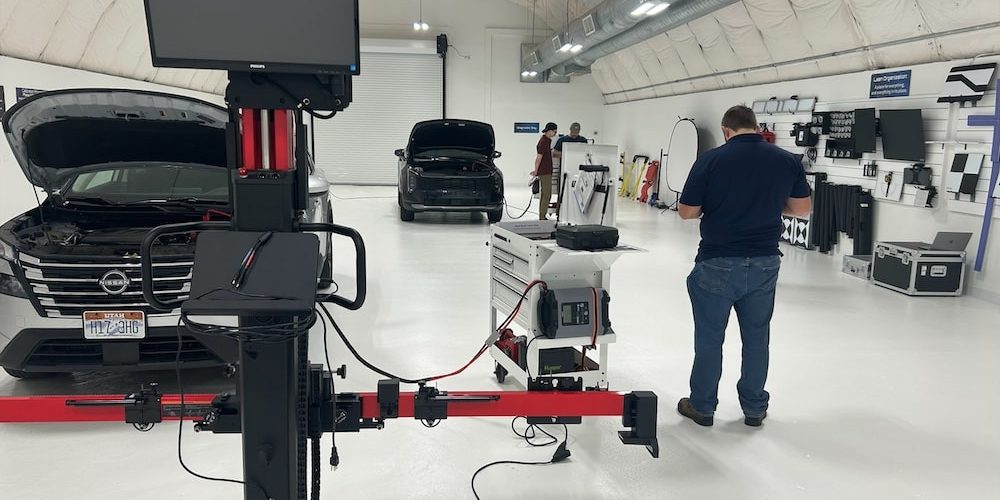
During calibration, the vehicle is placed in a controlled environment where specialized targets and tools are used to teach the system what “normal” looks like again. This process restores the system to OEM specifications and ensures that braking interventions happen at the correct time and distance.
Improper or skipped calibration can cause serious issues. An uncalibrated AEB system may brake too late, brake too early, or fail to brake at all. In some cases, it may trigger false warnings that distract the driver. Many insurance providers are also requiring proof of calibration for safety and coverage reasons.
Manufacturers and safety agencies consistently emphasize that calibration should only be performed by trained professionals using approved procedures. This is not a DIY process and should never be rushed or improvised.
Find an ADAS Calibration Center Near You
We covered what the AEB system does, why it’s part of the broader ADAS suite, what can trigger the warning light, and how calibration plays a major role in getting things back to factory standards. If your AEB light is on, the best next step is to have the system professionally diagnosed and calibrated. To help with that, we’ve made it easy for you to get the support you need. Visit our Find an ADAS Calibration Center page to locate a trusted shop near you. These centers are equipped to inspect your AEB system and perform precise recalibrations to meet OEM standards. Take the guesswork out of dashboard warnings and make sure your safety systems are working exactly as they should.


