
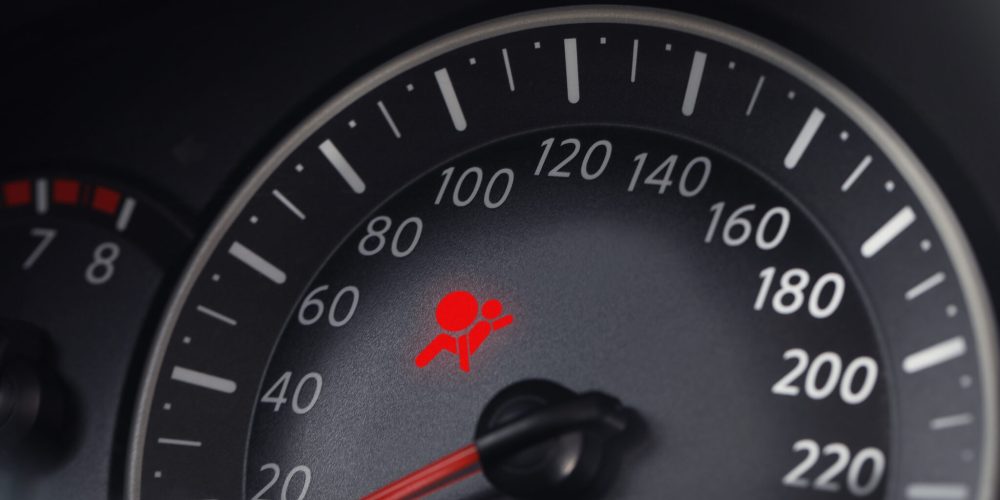
The airbag light is one of the few dashboard warnings that says nothing about how the car drives. The engine runs the same, the brakes feel the same, and it’s tempting to put it off until the next oil change. The problem is what the light actually means. Your vehicle’s supplemental restraint system has found a fault, and until it’s repaired, one or more airbags may not deploy in a crash. The cause can be as small as a loose connector under a seat or as serious as a failed control module, and the light alone won’t tell you which. In this post, we’ll cover what the airbag light means, the most common reasons it comes on, whether it’s safe to keep driving, and how the problem gets diagnosed and fixed.
What Does the Airbag Light Mean?
The airbag light is the warning indicator for a vehicle’s supplemental restraint system (SRS). On most vehicles, it shows a seated figure with a circle in front of it, sometimes with the letters SRS or AIRBAG.
When you start your vehicle, the SRS module runs a self-test, briefly illuminating the light. If it stays on, flashes, or appears while driving, the system has detected a fault and stored a diagnostic code.
The SRS includes more than airbags. It also monitors:
- Front and side impact sensors
- Airbag inflators throughout the vehicle
- Seat belt pretensioners
- Occupant classification sensors
- Steering wheel clock spring
- Wiring and electrical connections
A fault in any of these components can trigger the warning. Because airbags are a critical part of a vehicle’s passive safety system, the light should never be ignored. According to NHTSA, frontal airbags have saved more than 50,000 lives over three decades. When the warning light is on, one or more restraint components may be disabled, which reduces protection during a collision.
Common Reasons the Airbag Light Comes On
Most airbag faults trace back to a short list of causes. Technicians see these again and again, and the stored code usually points directly at one of them. Common causes include:
- Seat sensors and wiring: Loose under-seat connectors, damaged wiring, or malfunctioning occupant sensors can trigger SRS faults.
- Worn clock spring: This component maintains electrical connections to the driver’s airbag as the steering wheel turns. Failure may also disable the horn, steering wheel controls, or steering angle sensor.
- Crash data or module failure: After an airbag deployment, the SRS module may require replacement or an approved reset procedure. Water damage can also cause module failure.
- Seat belt components: Faulty pretensioners, buckle switches, or wiring can trigger the light.
- Impact sensors: Sensors damaged during collisions or affected by corrosion may send incorrect signals.
- Low system voltage: Weak batteries, failing alternators, or voltage fluctuations can set SRS fault codes.
- Aftermarket modifications: Improper seat replacements, steering wheel modifications, or previous collision repairs can interfere with the system.
One additional concern is the Takata airbag recall. Millions of vehicles were recalled because defective inflators could rupture during deployment. This issue does not necessarily trigger the airbag warning light, so owners should check their VIN using NHTSA’s Takata recall information.
Can You Drive With the Airbag Light On?
Mechanically, yes. The light has no effect on the engine, transmission, brakes, or steering, and the vehicle will pass most state inspections that do not include a restraint system check. However, being able to drive does not mean the vehicle is fully safe.
The Insurance Institute for Highway Safety reports that frontal airbags reduce driver deaths in frontal crashes by approximately 29%. When the SRS warning light is illuminated, some of that protection may be unavailable. Depending on the fault, the system might disable the driver’s airbag, passenger airbag, or other restraint components. Drivers cannot determine which components are affected simply by looking at the dashboard. Certain sensor faults may also interfere with proper airbag deployment decisions, including how the system responds to different occupant sizes and seating positions.
For these reasons, an illuminated airbag light should be diagnosed promptly. Although it does not necessarily mean the vehicle will stop operating, delaying repairs increases the risk of inadequate protection during a collision. If the light is flashing rather than steady, or comes on immediately after a collision, move it to the top of the list.
How to Diagnose and Fix an Airbag Light
Diagnosing an airbag warning starts with a scan tool capable of accessing the SRS module. Basic OBD-II readers often cannot retrieve airbag-specific trouble codes.
A qualified technician reads the stored codes to identify the affected circuit, whether it involves an airbag inflator, pretensioner, sensor, wiring connection, or control module. Like other ADAS error codes, these codes identify where further investigation is needed rather than confirming which part requires replacement.
The technician then follows manufacturer-approved diagnostic procedures to verify the fault. This may involve inspecting connectors, checking wiring, testing power and ground, or evaluating sensor information.
Once the cause is corrected, the technician clears the code and verifies that the SRS self-test passes.
If airbags or pretensioners are deployed during a collision, those components must be replaced according to manufacturer instructions. The SRS module may also require replacement, programming, or an approved reset procedure.
Why ADAS Calibration Matters After a Collision
Airbag repairs are only one part of restoring vehicle safety after an accident.
Collisions can also affect the cameras and radar sensors responsible for automatic emergency braking, adaptive cruise control, and lane-keeping assistance. Even minor sensor misalignment can affect performance without producing an obvious dashboard warning.
Manufacturers specify ADAS calibration requirements following certain repairs, including work involving bumpers, windshields, sensors, and structural components. According to AAA, ADAS components can account for as much as 37.6% of collision repair costs.
After a collision, ask the repair facility for calibration documentation confirming that required procedures were completed. Proper ADAS calibration helps restore the safety systems designed to prevent collisions, while SRS repairs restore those intended to protect occupants during one.
How Much Does It Cost to Fix an Airbag Light?
Repair costs vary depending on the vehicle and the component causing the warning. Here are the estimated ranges:
| Repair Type | Estimated Cost |
| SRS diagnostic scan | $100-200 |
| Clock spring replacement | $200-600 |
| Passenger occupant sensor replacement | $300-900 |
| Impact sensor replacement | $150-400 |
| SRS module reset | $100-300 |
| SRS module replacement and programming | $500-1,200 |
| Airbag replacement | $1,000-3,000 per airbag |
| Seat belt pretensioner replacement | $200-700 each |
Minor wiring or connector problems may cost relatively little to repair, while deployed airbags and damaged control modules can significantly increase expenses. The best way to avoid unnecessary costs is through accurate diagnosis before replacing components. Simply clearing the warning code without fixing the underlying problem does not restore the system’s protection.
Ultimately, the airbag light should be treated as a safety warning, not just a dashboard inconvenience. Addressing the cause quickly helps keep the restraint system ready when it matters most.
Find a Qualified Shop for Your Vehicle’s Safety Systems
An airbag light is easy to live with, and that is exactly why it gets ignored. The car drives the same with it on, but the system that protects you in a crash is telling you it may not do its job. Most causes are fixable once a scan identifies the fault, and the repair is often simpler than drivers expect. What matters is that the fault is actually repaired, not just cleared, and that everything connected to the repair is checked afterward. That is especially true after a collision, when the same impact that set the airbag light can also shift the cameras and radar your driver assistance features rely on. Car ADAS Solutions supports a network of calibration centers equipped with OEM procedures, proper targets, and trained technicians. Use the Car ADAS Calibration Center Locator to find a professional calibration center near you.


