
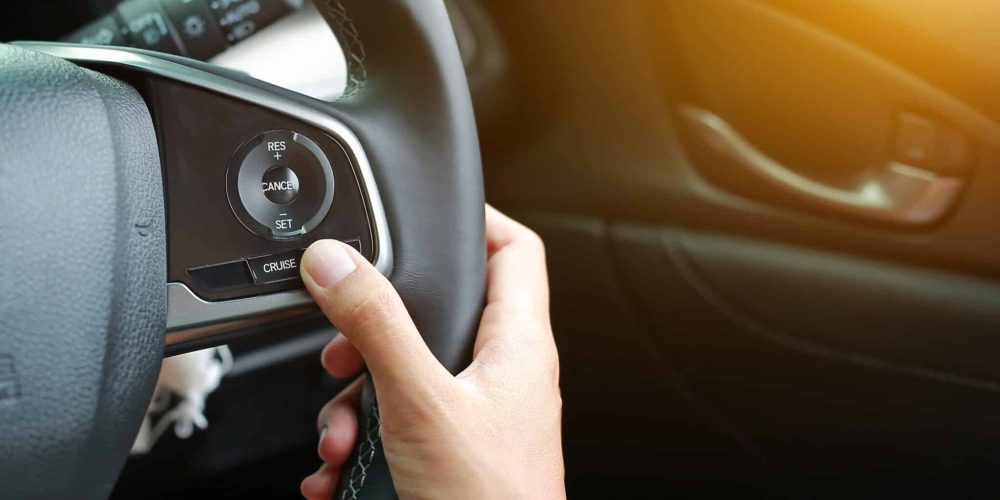
Cruise control used to be a fairly simple feature. You set a speed, the vehicle held it, and that was about it. Today, that is no longer the full story. Modern vehicles can be equipped with several types of cruise control, and some of the most advanced versions are integrated with ADAS technology. In this post, we will break down the different types of cruise control, including standard cruise control, adaptive cruise control, and stop-and-go cruise control systems. We will also explain how these systems fit into the broader ADAS picture, what sensors they rely on, what their limitations are, and why calibration becomes such an important issue after certain types of service.
What Are the Different Types of Cruise Control?
The different types of cruise control range from basic speed-holding systems to more advanced ADAS-supported features that can adjust vehicle speed based on traffic and road conditions.
The exact naming can vary by manufacturer, but most systems fall into four broad categories:
- Standard cruise control
- Adaptive cruise control
- Stop-and-go cruise control
Each one builds on the last. Standard cruise control focuses on maintaining a set speed. Adaptive cruise control adds distance management. Stop-and-go systems expand that function into slower traffic. Adaptive cruise control has come a long way over the years, so newer systems may use additional data, such as cameras, navigation information, speed sign recognition, or connected vehicle logic, depending on the manufacturer.
This is why the phrase cruise control types can be misleading if you treat every system the same. A basic cruise system from an older vehicle and an adaptive cruise system on a late-model vehicle may both use the word “cruise,” but they operate very differently.
How Do Different Types of Cruise Control Work?
A basic system mostly manages throttle input to maintain a selected speed. More advanced systems monitor the driving environment and communicate with multiple vehicle systems to accelerate, decelerate, or maintain distance.
Standard Cruise Control
Standard cruise control uses the vehicle’s speed information and throttle control to maintain the driver’s selected speed.
If the vehicle begins to slow while climbing a hill, the system may increase throttle. If the vehicle begins to exceed the set speed, it may reduce throttle. The driver remains fully responsible for braking, steering, and responding to traffic.
Adaptive Cruise Control
Adaptive cruise control adds forward monitoring.
A radar sensor, camera, or sensor fusion system detects a vehicle ahead and estimates distance and closing speed. The vehicle then adjusts throttle and braking to help maintain the selected gap.
This requires communication between multiple systems, including:
- Forward radar or camera systems
- Engine or powertrain control
- Brake control
- Transmission control
- Steering angle input
- Wheel speed data
- ADAS or cruise control modules
The system is constantly evaluating whether the vehicle ahead is within range, whether the driver’s selected speed is appropriate, and whether acceleration or deceleration is needed.
Stop-and-Go Systems
Stop-and-go systems extend adaptive cruise functionality into low-speed conditions.
They rely on the same general concept as ACC, but they must operate with more precision at lower speeds. In traffic, the vehicle may need to slow smoothly, stop behind another vehicle, hold position, and resume travel.
That requires reliable object detection and careful system logic. A low-speed error can feel very different to a driver than a highway-speed adjustment. The vehicle must respond in a way that feels predictable, comfortable, and within the system’s design limits.
How Does Cruise Control Fit Into ADAS?
Many advanced cruise features rely on the same sensors, modules, and decision-making systems used by other driver assistance technologies. To maintain following distance, the vehicle needs to detect what is ahead. That may involve radar behind the grille, a camera near the windshield, or a combination of both. Those same sensors may also be tied to other features, such as forward collision warning, automatic emergency braking, lane support systems, or traffic sign recognition.
This is why a repair that appears unrelated to cruise control can still affect cruise control performance.
For example:
- A windshield replacement can affect a forward-facing camera.
- A front bumper repair can affect radar position.
- A grille replacement can affect radar coverage.
- Suspension work can affect vehicle attitude and sensor aim.
- A wheel alignment can affect how the vehicle’s path is interpreted.
- Collision damage can shift brackets, mounting points, or sensor orientation.
In a modern vehicle, cruise control is often part of a connected ADAS ecosystem. When one part of that ecosystem is disturbed, the effects can extend across many features.
What Limitations Do Different Cruise Control Systems Have?
All cruise control systems have limitations. These systems assist, not replace, an attentive driver.
Standard Cruise Control: Can maintain speed but cannot react to traffic, brake for stopped cars, or adjust for weather.
Adaptive Cruise Control (ACC): May struggle with sharp curves, cut-in vehicles, poor weather, dirty sensors, and faded lane markings. The IIHS emphasizes that drivers must stay engaged with Level 1 and 2 systems.
Stop-and-Go Systems: Can create false confidence. They may not always resume automatically after a long stop and may not respond as expected in dynamic low-speed traffic.
Drivers must still be engaged and responsive at all times. These systems are meant to make driving safer, but they are not perfect.
When Does Cruise Control Calibration Matter?
Cruise control calibration is extremely important for adaptive cruise control and stop-and-go systems. These features often depend on radar, cameras, or sensor fusion. If those sensors are disturbed during service or repair, calibration may be required before the system can operate correctly.
The most important rule is simple: follow the OEM procedure for the specific vehicle.
Common situations where cruise control-related calibration may matter include:
- Windshield replacement near a forward-facing camera
- Front bumper removal or replacement
- Grille replacement
- Radar sensor removal, replacement, or bracket repair
- Collision repair near sensor mounting points
- Wheel alignment
- Suspension repair
- Steering angle sensor service
- Camera or module replacement
- Structural repairs that may affect sensor orientation
- Software updates or module programming when directed by OEM procedures
For adaptive cruise control, calibration accuracy is especially important because the system may be making speed and following-distance decisions based on sensor inputs. If those inputs are wrong, the vehicle’s response may be wrong too. This is why missed calibrations are such a concern in collision repair, glass replacement, and mechanical service. The vehicle may leave the shop looking repaired, but the ADAS system may not be fully functional.
Start or Grow Your ADAS Sensor Calibration Center with Car ADAS
The different types of cruise control on today’s vehicles go far beyond the basic speed-holding systems many drivers are familiar with. Standard cruise control, adaptive cruise control, and stop-and-go functionality each bring a different level of capability, and the more advanced the system becomes, the more closely it ties into ADAS features like radar, cameras, and sensor-driven vehicle response. The biggest takeaway is that cruise control is no longer just a convenience feature. In many vehicles, it is part of a broader safety and driver-assistance system that depends on proper alignment, correct sensor performance, and OEM-aware service procedures. As these technologies continue to become more common, repair professionals who understand how cruise control fits into ADAS will be in a much stronger position to serve customers accurately and avoid missed calibration steps. Car ADAS offers turnkey support for building an ADAS calibration center, including framework, software, training, and support. Within about 45 days, you can be fully equipped to meet the rising demand for ADAS services in your area. Contact us to learn more.


