
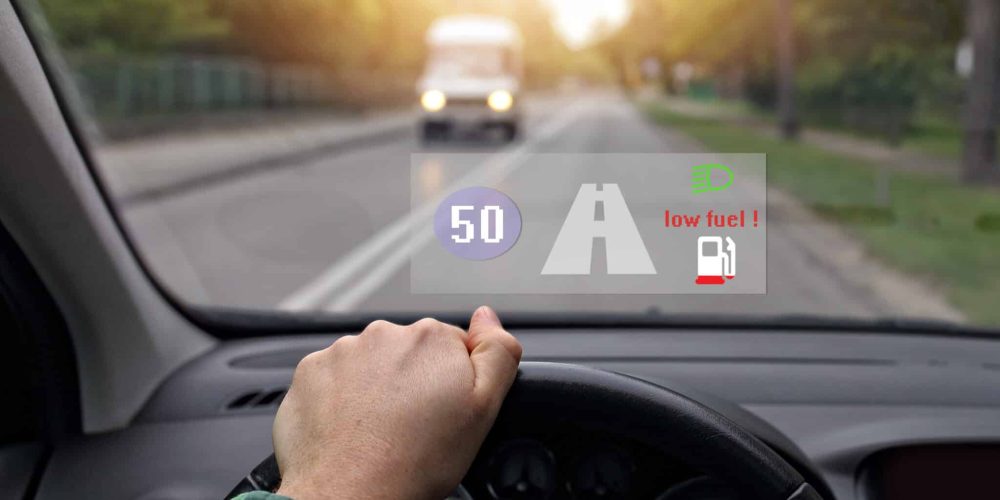
The first time you drive a vehicle with a heads up display, the effect is hard to miss. Your speed appears to float just above the hood, in focus, without you ever looking down at the gauge cluster. Navigation arrows, speed limit signs, and driver assistance alerts can all show up in the same place. It looks like the information is painted on the road, which is exactly the point, since the entire purpose of the technology is to keep your eyes forward. What most drivers never think about is how much precision goes into putting that image in the right spot, and what happens to it when the windshield gets replaced. In this post, we’ll cover what a heads up display is, how the projection actually works, what these systems show and where they fall short, and why HUD-equipped vehicles need particular attention after a repair.
What Is a Heads Up Display?
A heads up display, usually shortened to HUD, is a system that projects driving information into the driver’s forward field of view so it appears to hover over the road ahead. The technology started in military aircraft, where pilots could not afford to look down at instruments during critical moments, and it migrated into cars for the same reason. Every glance at a gauge cluster or center screen takes your eyes off the road, and the National Highway Traffic Safety Administration (NHTSA) ties thousands of deaths each year to distracted driving in its crash data. A head up display exists to move the most important information to where you are already looking.
A heads up display is a display technology, not a sensor system. It does not watch the road, make decisions, or intervene the way advanced driver assistance systems (ADAS) do. Instead, it is often the messenger for those systems, showing you the alerts and status information that features like lane keep assist and adaptive cruise control generate. Automakers offer HUDs across a wide range of vehicles today. HUDs come in two main forms: windshield-projected systems, which use the glass itself as the display surface, and combiner systems, which project onto a small clear panel that rises from the dashboard.
How a Heads Up Display Works
A windshield HUD is a precision optical system built into the top of the dashboard. A small, extremely bright display unit, typically a high-luminance LCD or a DLP projector, generates the image. That image bounces off a series of mirrors inside the housing, including an aspheric mirror shaped to correct for the curvature of the windshield, and then reflects off the inside surface of the glass into the driver’s eyes.
The clever part is where the image appears to be. The optics are designed so the graphics form a virtual image that seems to float out past the windshield, usually around two meters or more ahead of the driver, rather than sitting on the glass itself. That distance is what makes a HUD comfortable, because your eyes stay focused near the road instead of refocusing between far traffic and a near screen. It is also why the system adjusts brightness automatically against ambient light, and why the mirror angle can be tuned to the driver’s seating height.
The windshield itself is an optical component in this system, not just a surface. HUD-compatible windshields are built with a wedge-shaped inner vinyl layer that is slightly thicker at the top than the bottom. Without that wedge, the image reflects off both the inner and outer surfaces of the glass and the driver sees a doubled, ghosted image. This is the detail that becomes important later, because it means the glass is engineered for the projection, and glass without that construction cannot display the image correctly no matter how well it is installed.
What a HUD Shows and Where It Falls Short
Most systems display the essentials: current speed, posted speed limits picked up by the camera, turn-by-turn navigation arrows, and alerts from the driver assistance systems, such as forward collision warnings, lane departure indications, blind spot alerts, and the set speed and following gap for adaptive cruise control. Newer augmented reality HUDs go further, overlaying graphics that track the actual road, such as an arrow that appears to lie on the exact lane where your turn is.
The limitations are just as practical. Bright, low-angle sunlight can wash out the image, and glare on the glass can make it harder to read. Polarized sunglasses are a famous conflict, since the reflection off the windshield is polarized light, and many polarized lenses filter most of the image away. Height and seating position matter, because a driver sitting outside the designed viewing area sees a distorted or clipped image. And there is a human factor limit: a display meant to reduce distraction can create it if it is loaded with too much information, which is why most vehicles let you choose what appears and where. None of these are reasons to avoid the feature. Instead, they are reminders that a HUD is a carefully aimed optical system with real physical constraints.
What Happens to a HUD After a Windshield Replacement
This is where the technology stops being an interesting feature and starts being a repair consideration. Because the windshield is part of the optical path, a HUD-equipped vehicle requires HUD-specific glass, with the wedge construction and optical quality the projection depends on. Install a standard windshield on a HUD-equipped vehicle, and the display comes back ghosted, doubled, dim, or distorted, even though the glass fits perfectly and looks identical from the outside. The same applies to aftermarket glass that claims compatibility but does not hold the optical tolerances of the original part. The glass and the systems behind it are not interchangeable parts, and a shop quoting a windshield replacement on a HUD-equipped vehicle should be specifying the correct part number from the start.
Why ADAS Calibration is Needed
The windshield also carries something the HUD does not control: the forward-facing camera mounted behind the glass near the rearview mirror. That camera feeds lane keeping, emergency braking, and other assistance systems, and its aim is set relative to the vehicle with a precision measured in fractions of a degree.
Replacing the windshield disturbs that camera no matter how careful the installation is, which is why most manufacturers require a camera calibration after any windshield replacement on a camera-equipped vehicle. Depending on the make and model, that means a static calibration against targets in a controlled space, a dynamic calibration performed on the road, or both. The display can look flawless while the camera behind the same piece of glass is aimed at the wrong part of the road, and no dashboard light will tell you. A perfect image is not evidence of a calibrated camera.
Find a Professional ADAS Calibration Center Near You
A heads up display is a precision optical system, not a screen stuck to the glass. The projector, the mirrors, and the windshield itself all have to work together to put a focused image exactly where the driver’s eyes expect it, which is why HUD-equipped vehicles use specific glass rather than generic replacement windshields. That precision has a direct consequence after any repair involving the windshield. Installing the wrong glass can leave the image distorted or doubled, and the forward-facing camera mounted behind that same windshield has to be recalibrated regardless of how the display looks. A vehicle can leave the shop with a clean dashboard and a perfect-looking HUD while the camera behind it is aimed at the wrong part of the road. In order to have confidence in your car, you will need to get the camera and ADAS system professionally calibrated after a windshield repair. Car ADAS Solutions supports a network of calibration centers equipped with OEM procedures, proper targets, and technicians trained for this work. Use the Car ADAS Calibration Center Locator to find a professional calibration center near you.


