
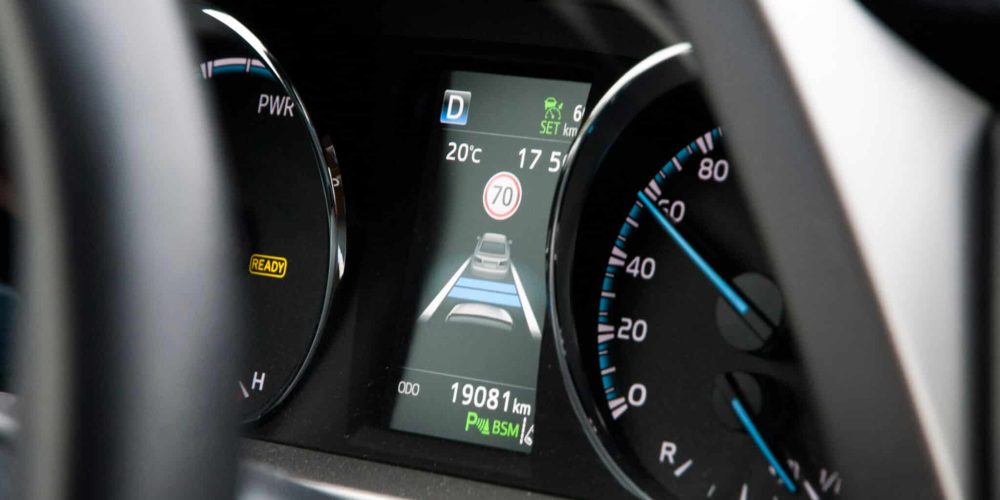
Cruise control is not as straightforward as it used to be. What once meant simply setting a speed and letting the vehicle maintain it has evolved into something much more advanced. If you have ever looked at a vehicle feature list and wondered what intelligent cruise control actually does, you are not alone. In this post, we will break down what intelligent cruise control is, how it works, how it compares to standard and adaptive cruise control, and what features may be included in more advanced versions. We will also explain how intelligent cruise control fits into ADAS, what its limitations are, and why calibration can become necessary after certain repairs. By the end, you will have a clearer understanding of what this technology really means and why it matters for both vehicle safety and modern repair workflows.
What Is Intelligent Cruise Control?
Intelligent cruise control Nissan’s adaptive cruise control system that they put in Nissan and Infiniti vehicles. Nissan’s Intelligent cruise control is an advanced driver assistance feature that helps their vehicles maintain a set speed while also adjusting to traffic ahead.
In a basic cruise control system, the driver sets a speed, and the vehicle tries to hold that speed until the system is canceled, the brakes are applied, or the speed setting is changed. But adaptive cruise control systems, such as Nissan’s Intelligent cruise control, go further. It can use forward-facing sensors, such as radar, cameras, or both, to monitor vehicles ahead and help maintain a selected following distance.
The system is not simply holding speed. It is gathering information from the driving environment and using that information to adjust acceleration and deceleration. Depending on the vehicle, intelligent cruise control may be able to slow down when traffic ahead slows, maintain a consistent gap, and accelerate again when the lane clears.
Is Intelligent Cruise Control the Same as Adaptive Cruise Control?
Adaptive cruise control generally refers to a system that maintains a set speed and adjusts that speed to help keep a preset distance from the vehicle ahead. Intelligent cruise control is a term used by Nissan to describe their version of that system, which uses the same core function.
How Does Intelligent Cruise Control Work?
Intelligent cruise control works by combining speed control with forward detection. Once the system is activated, the driver typically selects a desired cruising speed and following distance. The vehicle then uses sensor input to monitor traffic ahead. If the road is clear, the vehicle maintains the selected speed. If a slower vehicle is detected ahead, the system can reduce speed to help maintain the selected gap. When traffic clears, the system may speed back toward the set speed.
The exact process depends on the vehicle, but the system may rely on several inputs, including:
- Front radar sensors
- Forward-facing cameras
- Wheel speed sensors
- Steering angle information
- Brake system data
- Throttle and powertrain control
- ADAS control modules
More advanced versions may also use traffic sign recognition, navigation data, or lane information. This is what makes intelligent cruise control more complex than standard cruise control. It is not just asking, “What speed was selected?” It is also evaluating what is ahead of the vehicle, how close it is, how fast it is moving, and how the vehicle should respond.
What Features Can Intelligent Cruise Control Include?
Not every intelligent cruise control system includes the same features. Some systems are fairly straightforward and focus mainly on speed and distance control. Others include more advanced functions that make the system feel more aware of traffic, road conditions, and surrounding inputs.
Depending on the vehicle and year, intelligent cruise control may include features such as:
- Automatic speed adjustment based on traffic ahead
- Driver-selectable following distance
- Low-speed follow or stop-and-go functionality
- Resume capability after slowing or stopping
- Integration with forward collision warning
- Integration with automatic emergency braking
- Camera or radar-based vehicle detection
- Speed sign recognition
- Navigation-assisted speed changes
- Coordination with lane centering or steering assistance
These features can make driving feel smoother and less tiring, especially on highways or in traffic. Still, intelligent cruise control does not make a vehicle self-driving.
It assists with speed and following distance under certain conditions. The system still has operating limits, and performance depends on sensor visibility, calibration accuracy, road conditions, weather, software logic, and the vehicle staying within its intended use case.
When Does Intelligent Cruise Control Need Calibration?
Intelligent cruise control may need calibration any time the sensors or related vehicle systems it depends on are disturbed. That does not mean every repair automatically requires calibration. It means the correct procedure must be checked for the specific vehicle and repair event. Calibration requirements can vary by model, year, sensor layout, and system design.
In many vehicles, intelligent cruise control depends on forward-facing radar, cameras, or both. These components are often located near areas that are commonly repaired, removed, replaced, or adjusted.
Calibration may be required after:
- Windshield replacement near a forward-facing camera
- Front bumper removal or replacement
- Grille replacement
- Radar sensor removal or replacement
- Collision repair near sensor mounting points
- Bracket repair or sensor mounting changes
- Wheel alignment
- Suspension repair
- Steering angle sensor service
- Camera or ADAS module replacement
- Structural repairs that affect vehicle geometry
- OEM-directed software updates or module programming
Calibration is not just a nice-to-have. If missed, it can lead to incorrect readings, delayed responses, or total system failure, creating dangerous situations on the road. For example, these systems may misjudge distances, fail to detect obstacles, or provide false alerts, increasing the risk of accidents.
Build or Start an ADAS Sensor Calibration Center With Car ADAS
Intelligent cruise control is not just a convenience feature anymore. In many modern vehicles, it is part of a larger ADAS system that depends on cameras, radar, sensor alignment, and precise calibration to function correctly. That means repairs involving windshields, collisions, alignment changes, or nearby sensor components can have a direct impact on how the system performs. Understanding that connection is essential for accurate, safety-focused service and helps explain why certain repairs may involve calibration and why those steps should not be skipped. As these systems continue to become more common across the vehicle market, the need for ADAS knowledge and calibration capability will only keep growing. Car ADAS helps meet that need by offering a turnkey solution for building an ADAS calibration center, including framework, software, training, and support. Learn how to start or grow your own ADAS calibration center today.


